A patient coach that learns your patterns, re-evaluates them after every game and points you at the one thing that will take you higher. The engine, the statistics and the AI are just how it works out what to teach you next.
For anyone who knows how the pieces move, up to about 2000. Above 2000 it hasn't been tested with real players yet; if you're 2000+, tell us where it's wrong.
One minute, with sound: the board, the coach, the drills, and how to help.
You don't lose to new mistakes.
You lose to the same one again. A review shows you the blunder, the engine's better move and the evaluation falling off a cliff. Then the next game starts, and nobody tells you it was the same knight move, the same missed fork, the same rushed move with a minute on the clock as last week.
The research on learning says what fixes that: retrieving your own errors, spaced over days, with feedback about the move rather than about you. Rematch is built on it.
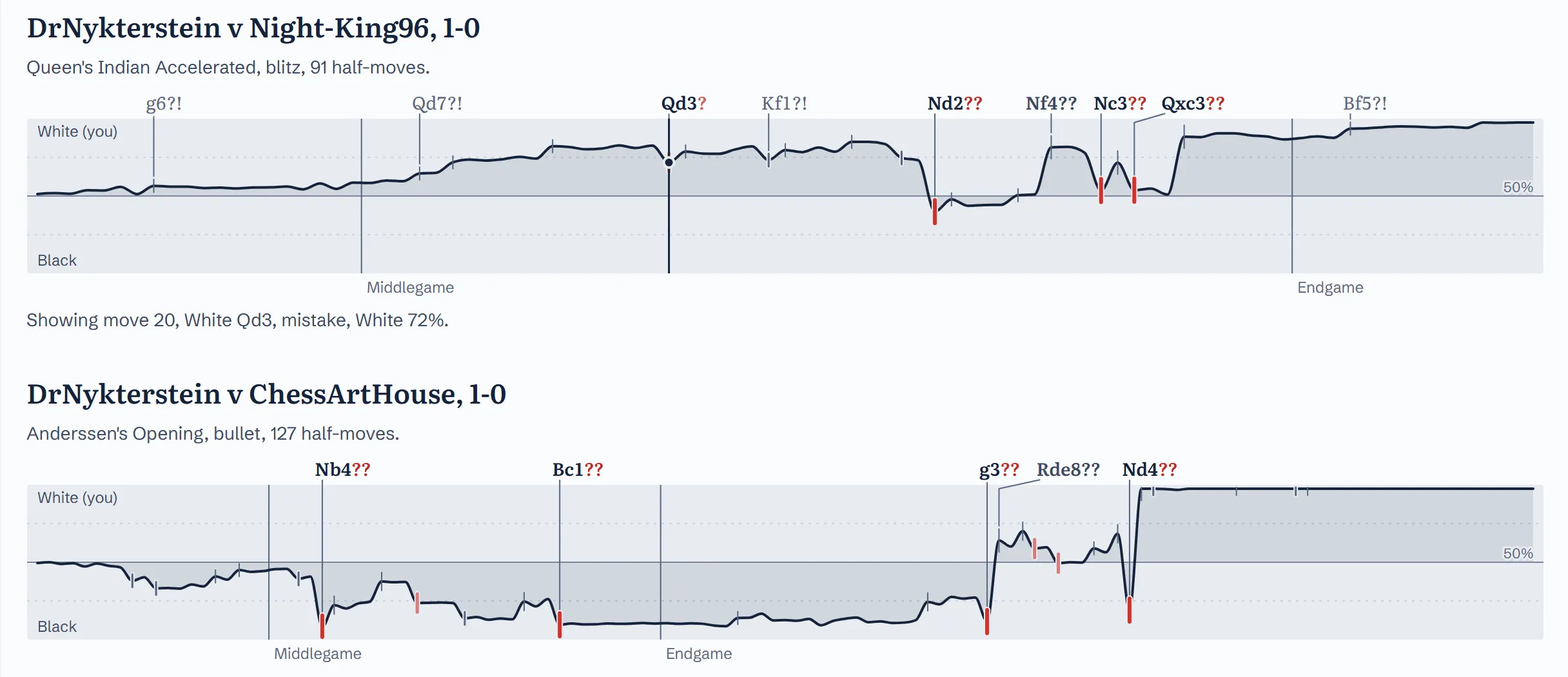
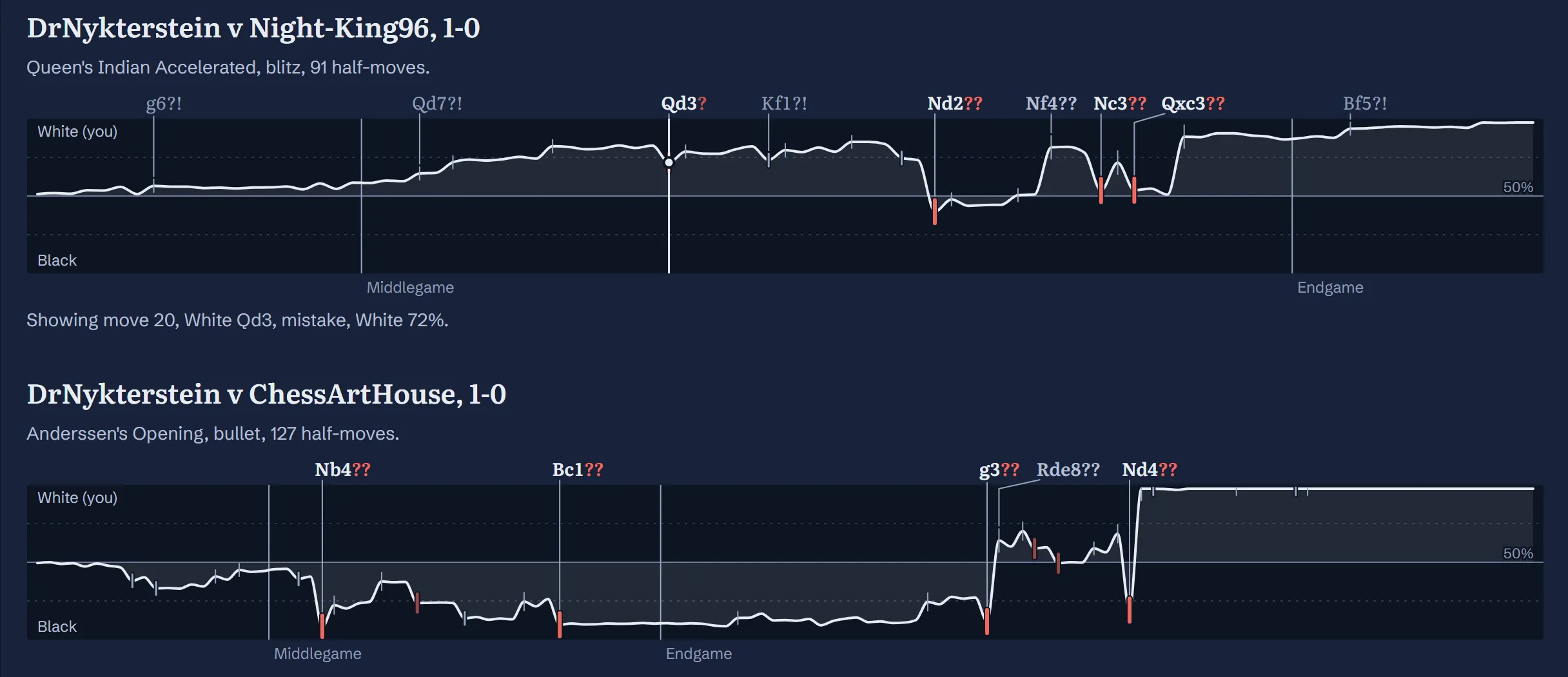
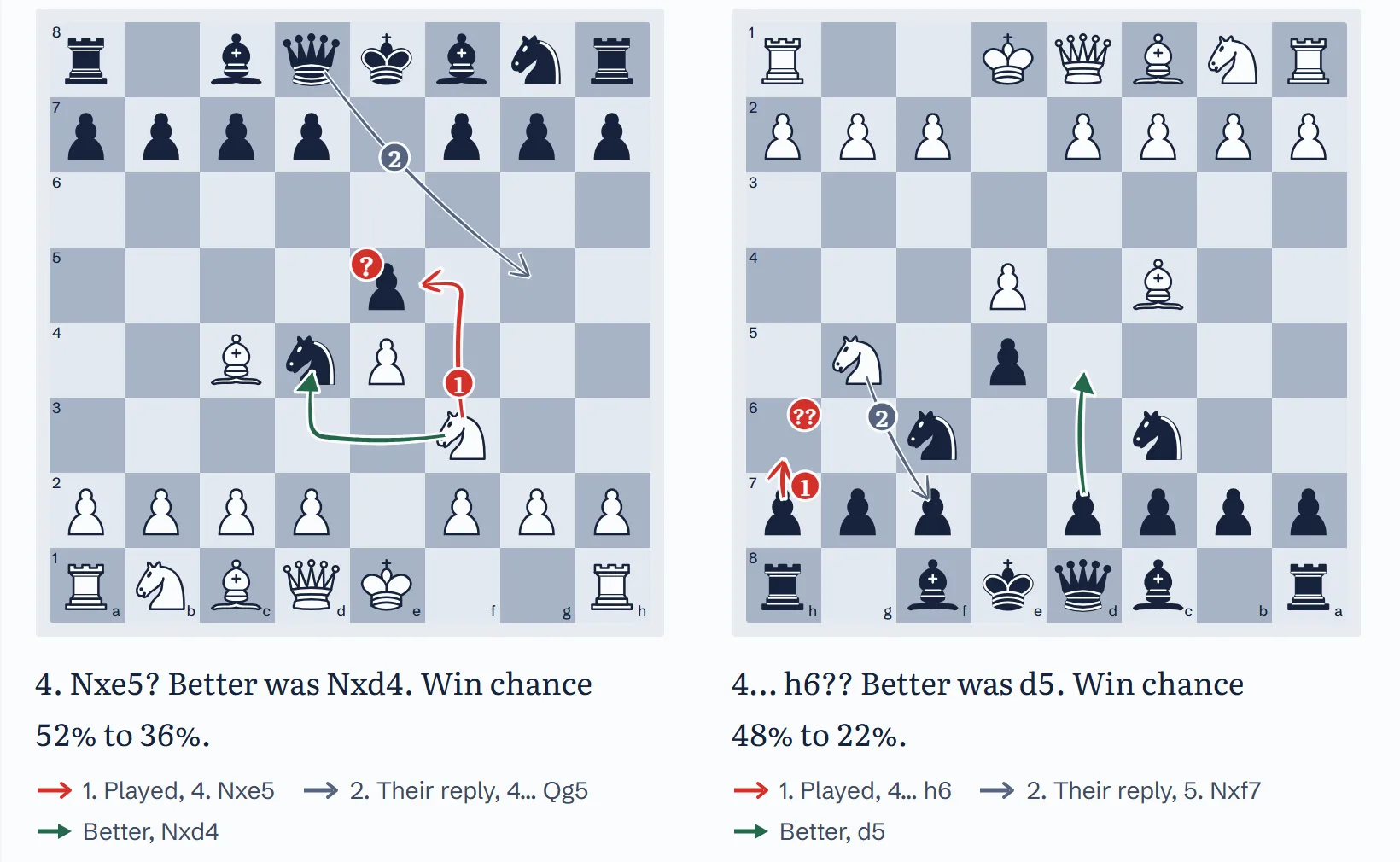
Two public Lichess games from the styleguide, two collapses, each marked ??.
What it does
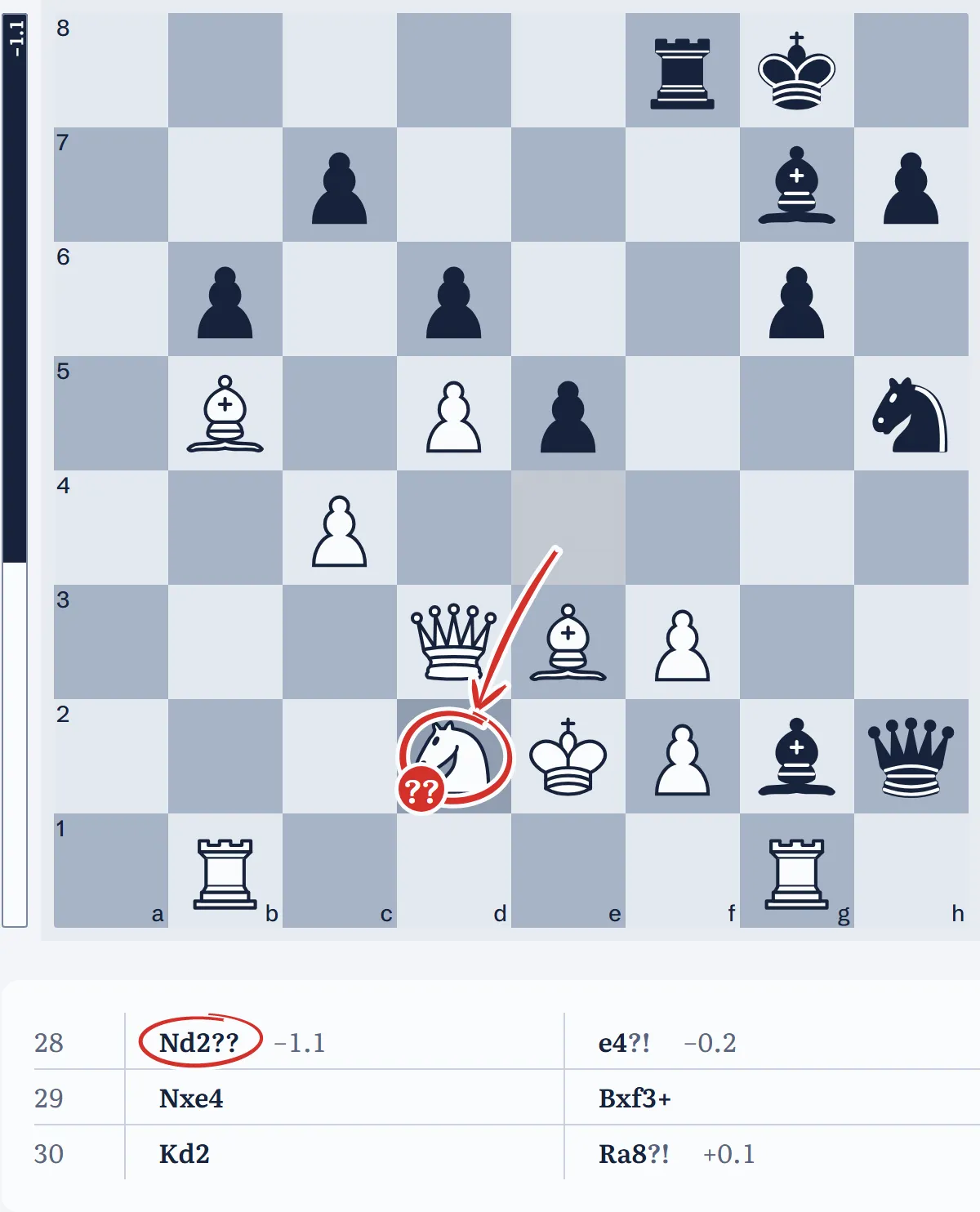
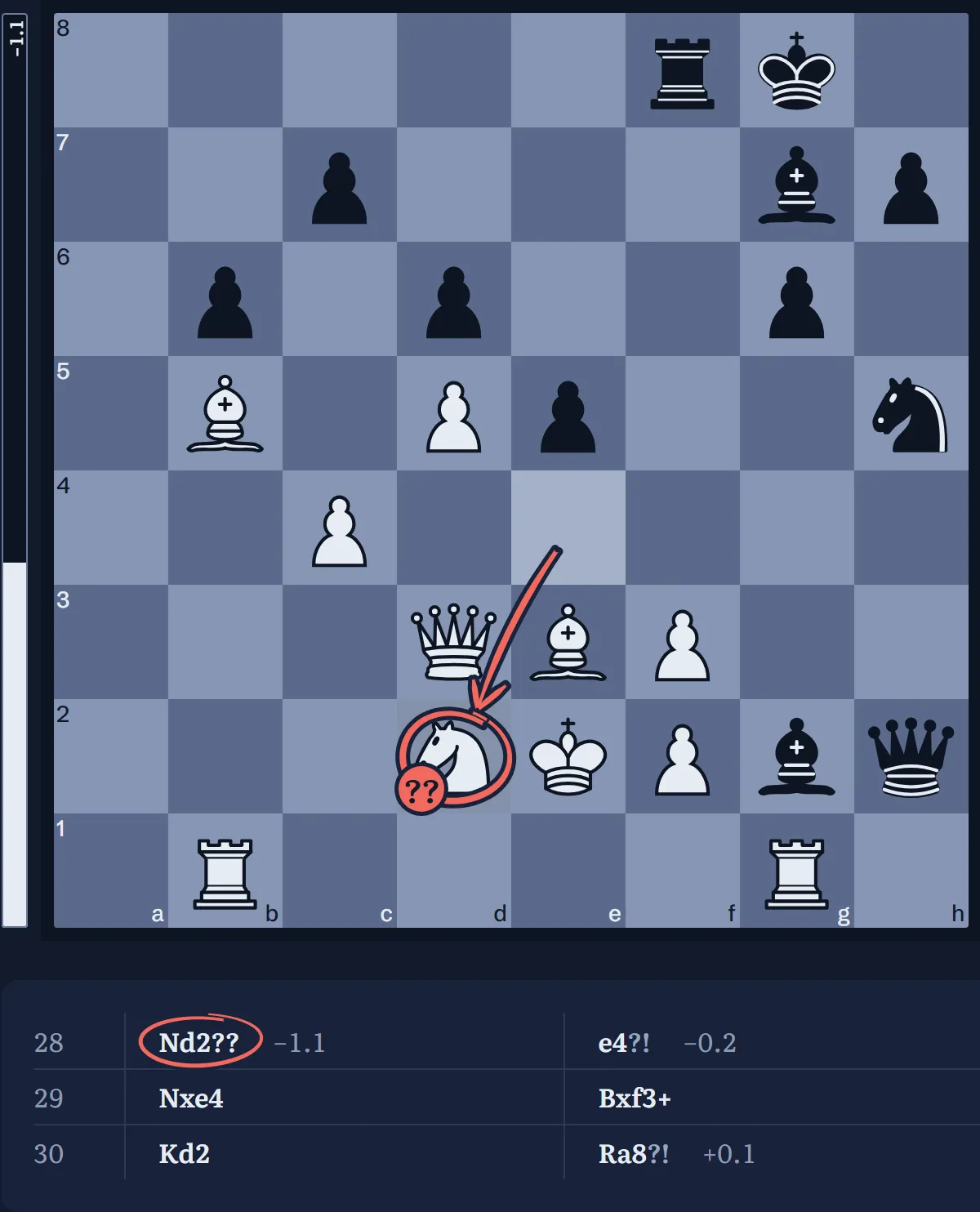
The screenshots are the app's own interface on its styleguide's demo data, never a player's account.
Every move, checked by Stockfish
Link your chess.com account and Rematch imports your games, keeps them in sync and analyses every move with Stockfish 19. The turning points are marked the way a coach marks a scoresheet: a red pen for your mistakes, the better move in green, and the evaluation graph showing where the game turned.
The engine settings are pinned, so the same position always gets the same verdict.
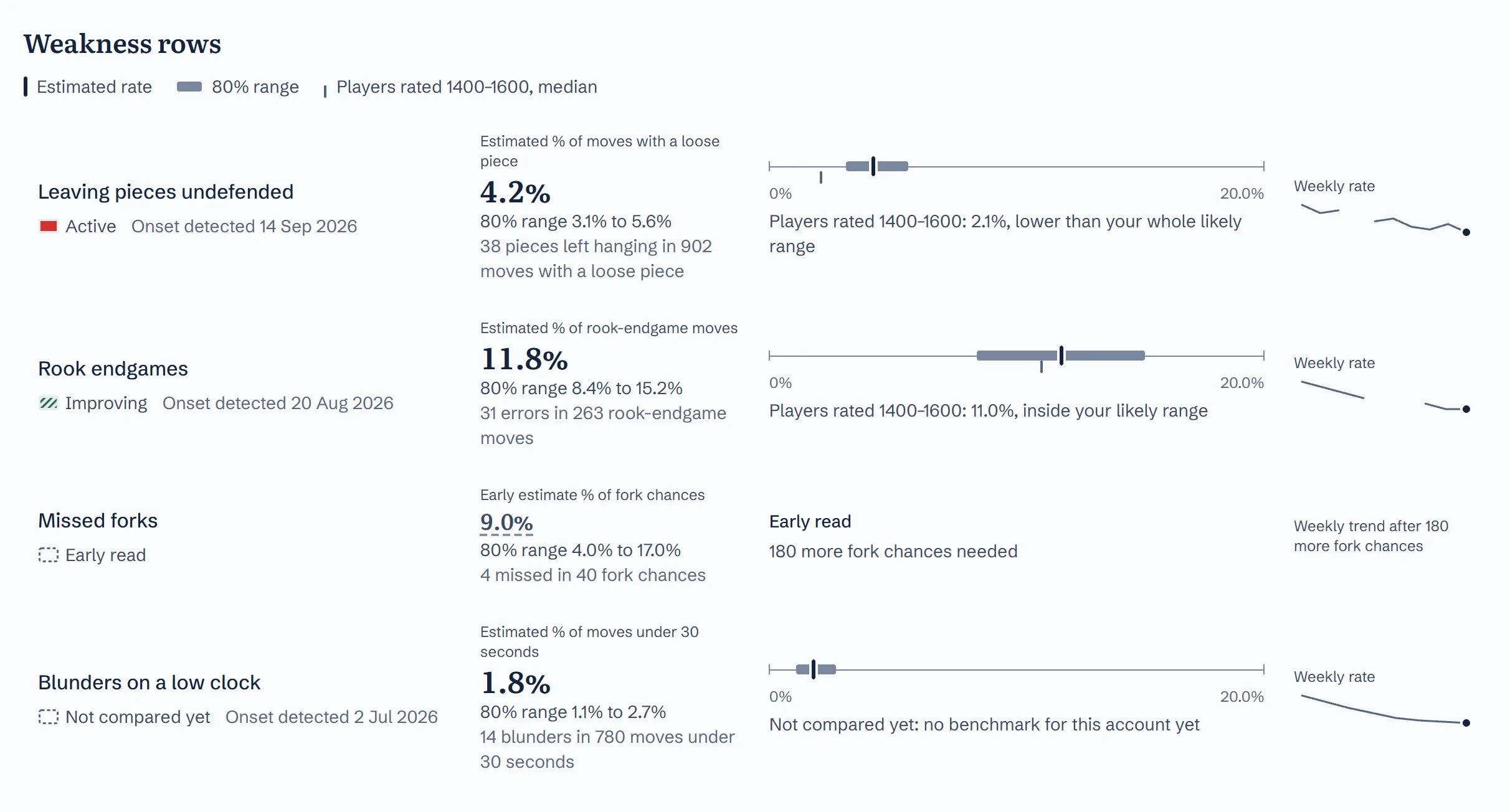
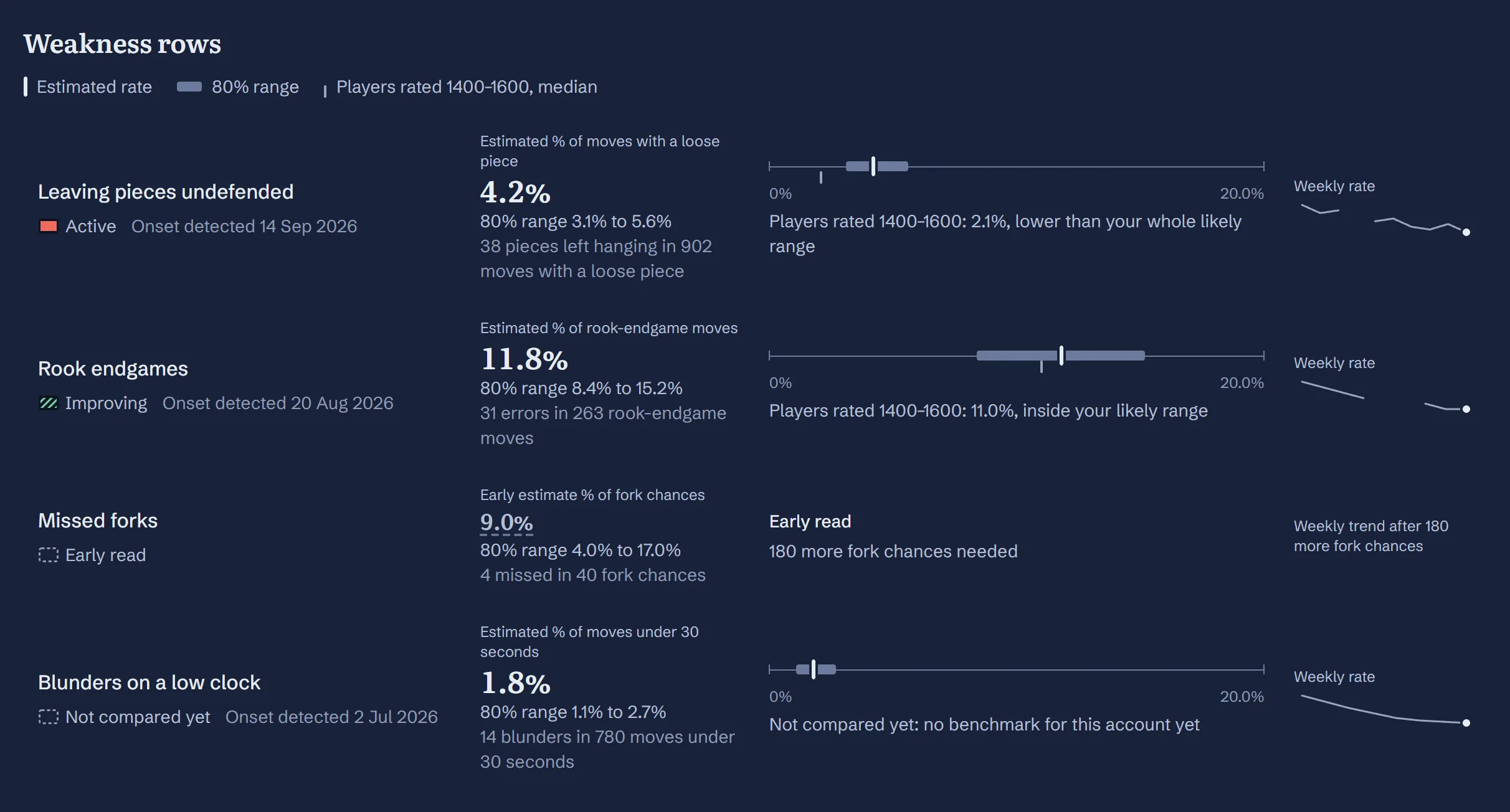
The mistakes you keep making, named
It counts each mistake per chance, not per game: a loose piece per move that had one, a missed fork per fork you had. Then it ranks them by what they cost, explains each in a sentence and compares you with players around your rating. Your strengths get the same treatment.
Every rate carries its count and an 80% range. A new pattern stays an early read until the evidence is there.
A coach that cites your games
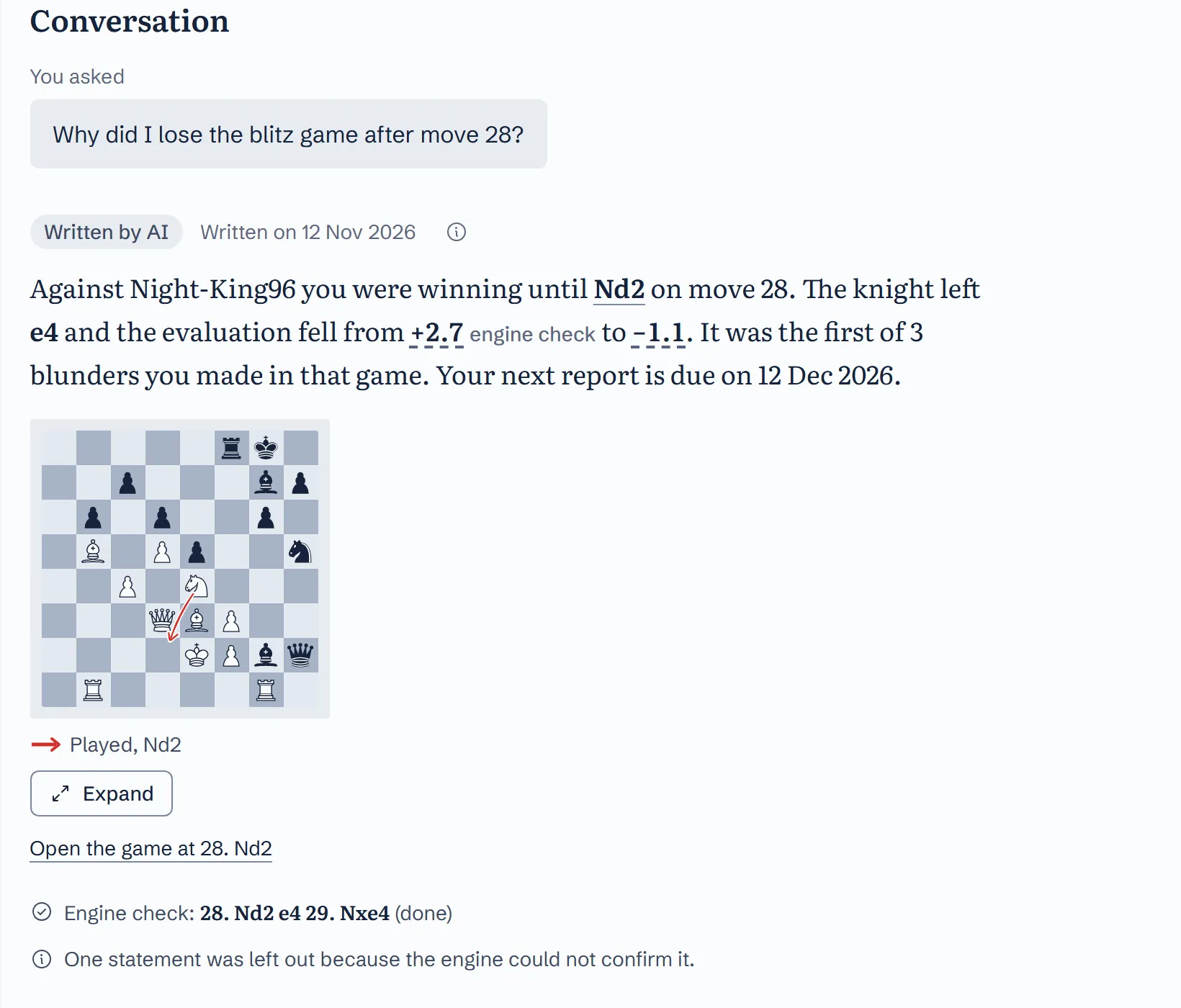
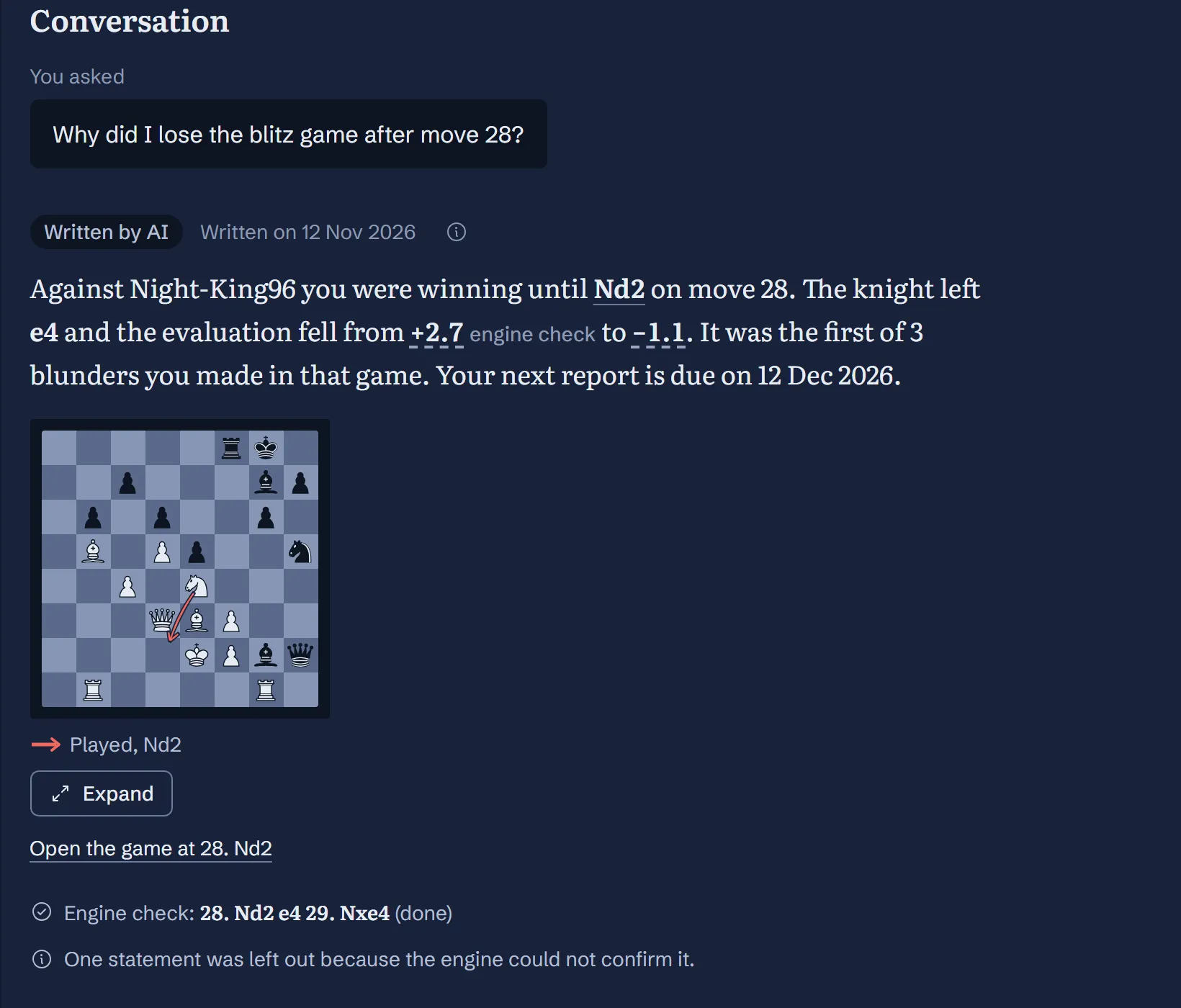
Ask why you lost after move 28 and the answer points at the position, the move and the evaluation, each one a link into the game. Claude writes the words. Stockfish and the app's own statistics supply every fact, and a validator checks each paragraph against your data before you see it.
What can't be checked is left out, and the answer says so. The AI is optional: without a key, every number is still there.
Your missed moments, back as drills
Positions where you missed a mate, a win or a short tactic, or blundered, come back as drills. Play your move, say whether you were sure, then see the verdict with the engine's line drawn on the board. A right answer returns after 1, 3, 7, 21 and then 60 days; a miss comes back tomorrow.
About one position in five is held back on purpose, so “Is it working?” can compare the patterns you drilled with the ones you didn't.
One focus a week, with a number to hit
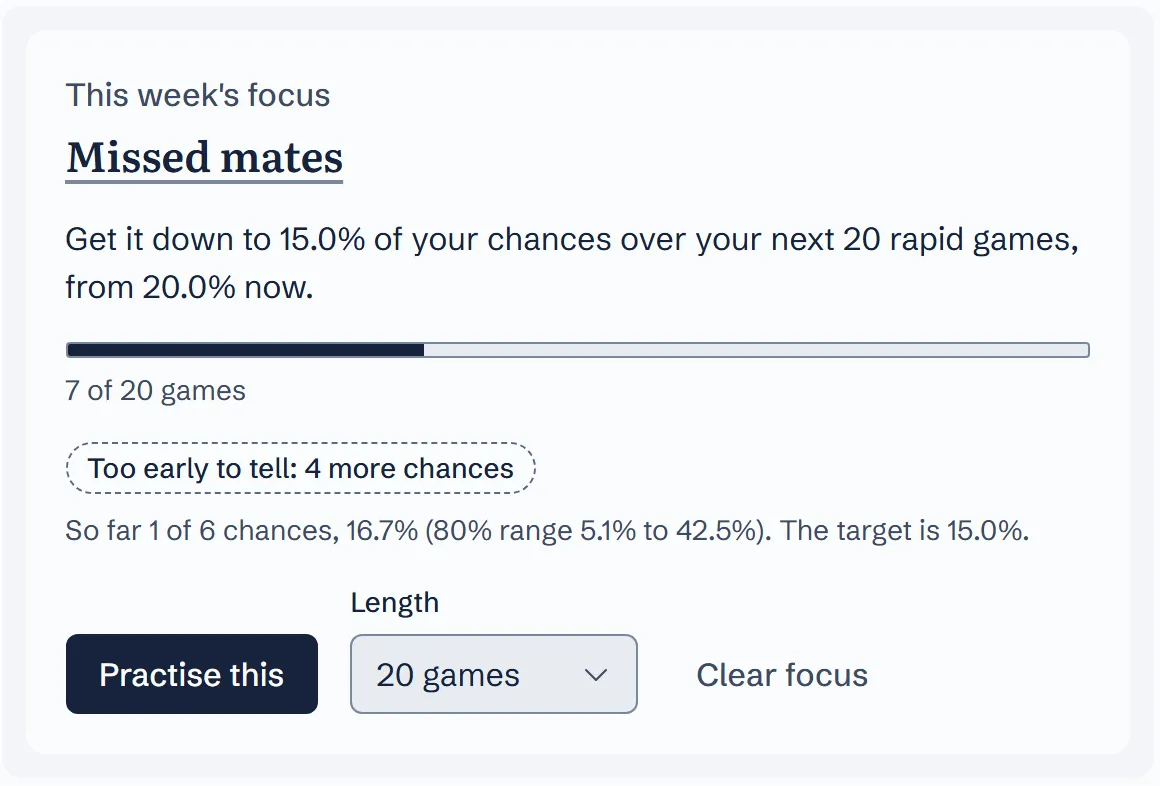
Rematch suggests the weakness that costs you most and sets a target from your own rate and your peers': get it down to a stated share of your chances over your next 20 games. Pick 10 to 40 games, and practise it straight from the card.
Under 10 chances it says “Too early to tell”. It compares you with the goal and never claims you improved.
What changed since your peak
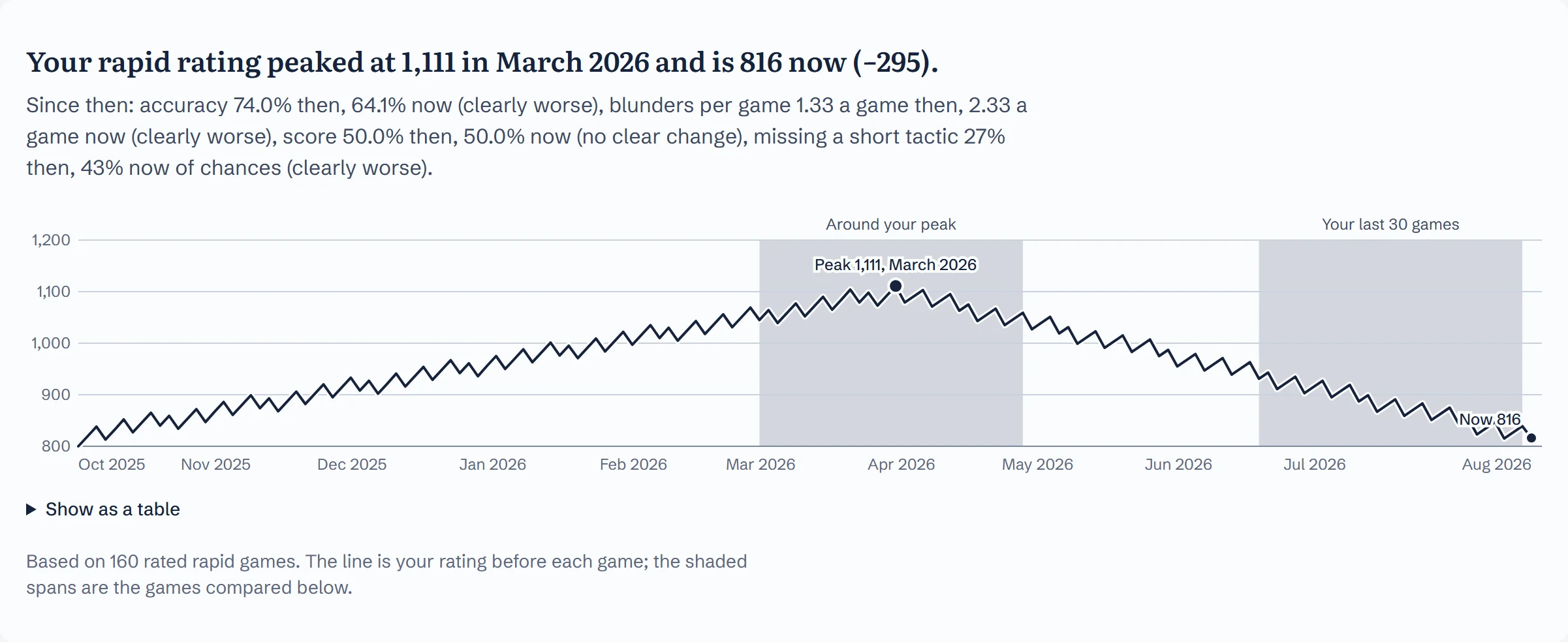
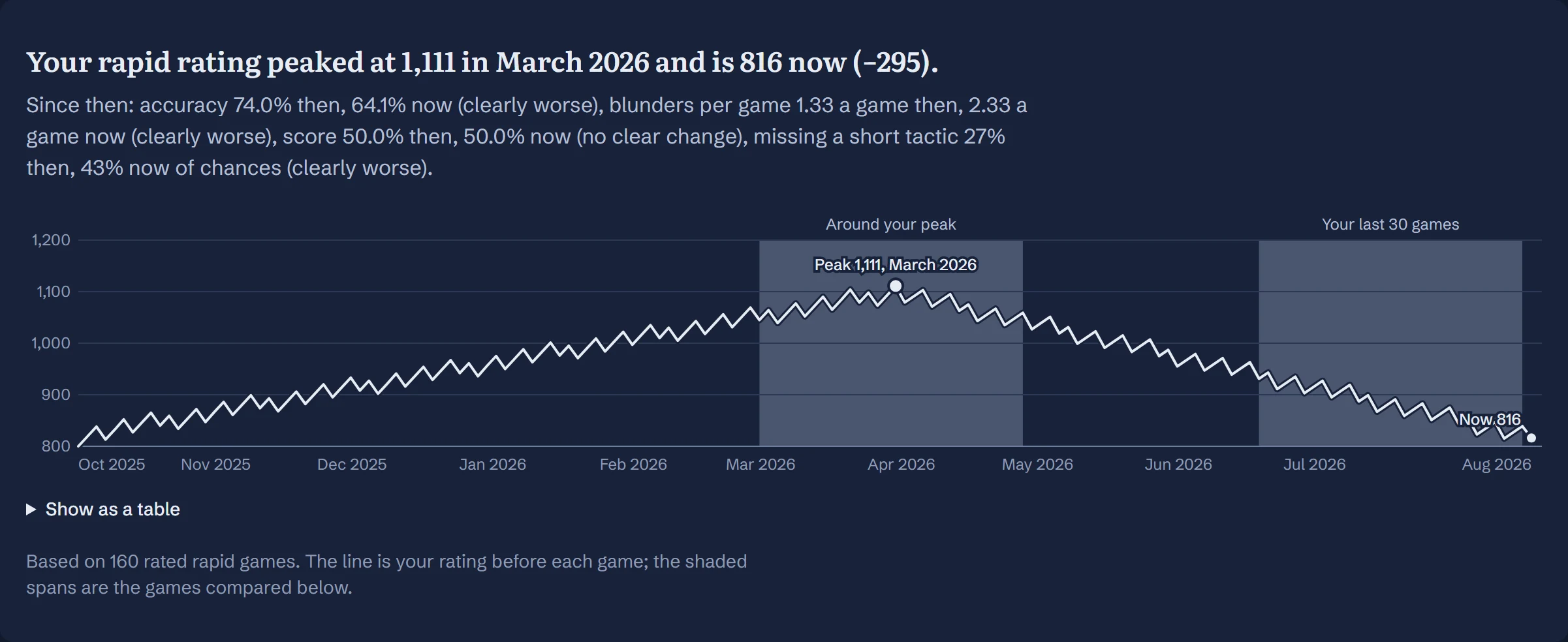
Your rating line with the peak marked, then the games around the peak against your last games: rating, accuracy, blunders per game, score and your top weaknesses, side by side.
A rating moves for many reasons, so a clearly worse measure is named as the likeliest place to look, never as the cause.
Every number shows its range.
Stockfish and our own statistics produce every fact. Claude only explains and prioritises those facts. Every claim in a report links to real positions from the player's games.
A count with every rate. “Based on 38 rapid games” sits beside the number it explains.
A range with every estimate. An 80% range, drawn and written out in words.
Unknown is never zero. Below 10 games there is no number, only “Need 9 more games”.
Better or worse only when it's clear. If the ranges overlap, it says “No clear change”.
Facts by reference. The AI can only cite positions, moves and numbers the app computed. A sentence that can't be checked is dropped before you see it.
How it works
A game becomes advice like this: Rematch imports it from chess.com, Stockfish 19 checks every move, the critical moves get a closer look, the profile counts what you keep getting wrong per chance, and the trainer brings your own missed moments back as drills. The coach is optional, and it only puts computed facts into words.
Import: chess.com only, public data, kept in syncRematch reads your public chess.com games from the monthly archives, newest first, and checks every linked account for new games every 30 minutes.
Engine analysis: Stockfish 19, win chance, accuracy, judgementsStockfish 19 searches every position at a fixed 1 million nodes, so the same position always gets the same number, and a drop of 15 win-chance points is a blunder, as on Lichess.
Enrichment: the critical moves get a closer lookUp to 30 critical moves a game get the engine's top three lines, a threat probe and motif tags.
Syzygy tablebases: perfect verdicts with five pieces or fewerIn an ending with five pieces or fewer, the Syzygy tables give the exact result, so a move that throws it away is counted for certain.
Maia-2: would a player at your rating have found it?If you run it, Maia-2 estimates how many players at your rating would have found the move, which tells a hard miss from an easy one.
The weaknesses: W1 to W12, each with a definition of a chanceEvery weakness is a count: events out of chances.
Rates and uncertainty: the prior, the 80% range, the seeded bootstrapEach rate is a Beta posterior with an 80% range, pulled towards your peers' rate until your own games outweigh it.
Peers: players you've faced, and the Lichess referenceEvery rate is compared with players like you: by default the chess.com opponents you've faced within 150 points of your rating.
Comparisons: White and Black, then and nowEvery number is split into your White and your Black games, and two periods are compared only when both have 10 games.
Strengths: what you do well, under the same rulesA strength passes the same gates as a weakness: a count, an 80% range and a comparison, so nothing is praised on thin evidence.
Trajectory: what changed since your peakYour rating line with its peak marked, and the games around the peak set against your last games, measure by measure.
The coaching input: one JSON document of everything the coach may citeEverything the coach may cite is one JSON document, written once per profile build and kept, so every answer can be checked against what the coach saw.
The AI coach: Claude writes the words, the validator decides what you seeClaude writes the words of reports and answers through reference tokens the server fills in, and a validator drops any paragraph it can't trace back to your data.
The trainer: your missed moments, spacedYour own missed moments come back as drills after 1, 3, 7, 21 and 60 days, and one in five is held back to measure whether drilling works.
The weekly focus and the overviewOne weakness a week, with a target rate over your next 10 to 40 games and a verdict only once there are 10 chances.
Storage, jobs and the web appPostgres holds the job queue and every computed fact, and the Next.js app reads them directly.
Privacy, honesty and the limitsYour games and analysis stay in your own Postgres, and Rematch reads only public chess.com data.
Solid lines always run. Dotted ones are optional: without Maia, the Lichess builds or an AI key, everything on a solid line still works. Postgres holds the job queue and every fact in between.
2026-11-26algo-5.0.0 stops calling the rating rising or fallingThe trajectory no longer tells a player or the coach that their rating is falling, rising, clearly worse or clearly better than at their peak. The headline states the peak, the current rating and the change as numbers ("Your rapid rating peaked at 1,080 in February 2026 and is 816 now (−264)."), and the then | now table shows both windows' average ratings and the difference, marked "Not called" (ADR 0116, #136).
Each milestone on GitHub has one epic per theme, a spec in the issue and its work as sub-issues. The order comes from a week of using it on my own account (824 rapid), ranked by what the research says should help a player improve.
Now
v0.2 Factual and deterministic foundationOne versioned recommendation algorithm: a manifest of every constant, protocol and prompt that shapes a recommendation, its id stamped on every row it writes, and a replay suite that proves the same games give byte-identical facts, profile and recommendations (ADR 0104).
v0.3 The evaluation labEvery layer measured against its own ground truth: Lichess puzzle themes, Syzygy, lila's accuracy formula, synthetic players and anonymised real ones. Quality, cost and latency KPIs with 80% intervals, a history per algorithm version, and an Evaluation page on the site.
v0.4 Patterns and progressionOne registry of versioned patterns (by motif, piece, phase, clock, opening, colour and after a loss), each admitted only after it passes its ground-truth suite, and a progression monitor that shows when a pattern started and whether it has recovered.
v0.5 Board, sound and clarityThe big UI round, from real-screenshot mockups the owner picks: sound in the trainer, a promotion picker and premoves, piece and board settings, an overview that leads with one trend and one focus, and "Why this?" on every recommendation.
v0.6 Practice habit and trainer depthTurn the trainer into a daily habit and give every weekly focus a drill: a streak that forgives a rest day, an opt-in morning email, an ETA for "Is it working?", opening-trap lines, a clock budget and won positions played out against Maia.
v0.7 More playersLichess accounts and PGN files as game sources, the app in more than one language, and the rating-band assumptions checked with players above 2000.
v1.0 MVPThe first complete release, declared in its own ADR: a stranger can sign up, link chess.com, practise daily, see whether it works, and delete everything when they leave.
Rematch is one maintainer and a lot of decisions written down. Here is where help moves it most.
Rust developers
The worker, the analysis pipeline, the profile engine and the coach's validator live in one Cargo workspace.
TypeScript and React developers
The Next.js app and its design system: the board, the eval graph, the charts and the motion around them.
Chess coaches and strong players
Tell us what a 1200 should practise and how a good coach would say it. Players rated 2000+ most of all: nobody at that level has tested it yet. There is an issue form for coaching ideas.
Designers
The annotated-scoresheet system is written down in DESIGN.md. Critique it, then extend it.
Players who test
Run it on your own games and tell us where it is wrong, unclear or slow.
AI-assisted pull requests are welcome: CLAUDE.md and the skills in .claude/skills are the house rules, for people and agents alike.
Questions
Is it free?
Yes. Rematch is open source under the AGPL-3.0: run it, read it, change it. If you run a modified version for other people, share your changes with them.
Can I sign up somewhere?
Not yet. Rematch is a beta (version 0.1.0) that you run yourself with Docker. Version 1.0 is reserved for the first complete release.
Why chess.com only?
To get one platform right first. The Lichess importer exists and is tested, but Lichess accounts are switched off for now (decision 0040). The opening explorer is built from the open Lichess game database; peer comparisons use the chess.com players you have faced.
What happens to my data?
When you run it yourself, your games and analysis stay in your own database. Rematch reads only public game data from chess.com, and its requests never carry your email address. If you switch the AI coach on, the computed facts it needs are sent to Anthropic to write the text. Accounts are for players aged 13 and over.
Do I need an AI key?
No. Without one, the analysis, every rate, the focus and the trainer all work, and reports show the numbers without commentary. With an Anthropic API key, the coach writes reports, answers your questions and writes a weekly review.
Is this cheating?
No. Rematch only reads finished games and never helps during one. Live assistance is banned on chess.com and Lichess, and it is a non-goal here.
How strong do I need to be?
For anyone who knows how the pieces move, up to about 2000. Above 2000 it hasn't been tested with real players yet; if you're 2000+, tell us where it's wrong. What it ranks and how the coach explains it follow your rating band.
What do I need to run it?
Docker with about 12 GB of memory assigned (a 16 GB machine) and about 10 GB of free disk. Node 22 and pnpm 12 if you want to work on the code. Getting started has the three commands.
Why I'm building this
My dad played chess his whole life. I'm not good at it, but every time I play I feel closer to him. He died recently, and Rematch is how I keep that going — a coach that shows me the mistake I keep making, the way he probably would have.